The promise of agentic AI for science is concrete: an agent surveys the literature, implements a method, runs the experiment, and reports what happened — compressing weeks of plumbing into an afternoon. The danger is just as concrete: unreviewed code, runs nobody can reproduce, and a model that states an invented number with total confidence. The unlock is not a smarter agent. It is a governed one.
The discovery loop is a long-horizon coding task
Strip away the lab coat and scientific automation is exactly the workload Cortex was built for: long-horizon, code-heavy, and only useful if the result can be trusted. The same validate-then-repair loop that keeps a coding agent honest — checking each step against acceptance criteria before accepting it — is what lets a researcher trust an output instead of re-deriving it by hand.
Why governance is the unlock
Four properties turn an exciting demo into a tool you can publish from:
- Capability policy — an agent running an experiment cannot reach past its mandate into unrelated systems or data.
- Append-only audit — every step, dataset, and command is recorded, so a result has a provenance trail.
- Isolation — each study runs in its own stack, so one experiment cannot contaminate another.
- Observability — a run is captured well enough to reproduce, not merely recounted.
an experiment run under policy# dispatch one service-scoped task under the built-in app-agent policy
$ cortex agent run \
    --policy app-agent \
    --service study-042 \
    --file experiment.md --wait

  → pinned dataset@v3 · seed=42 · 1,024 trials
  → every step validated, logged, and attributable
  → result + full provenance written to the run record
We don't just theorize this — we run it
omegaXiv is our autonomous research platform. It turns an open problem into a four-layer pipeline: a problem marketplace, a governed execution engine, compute and deployment, and a knowledge graph that remembers everything. The output isn't a chat log — it's a manuscript, the code, the artifacts, and the lineage, packaged so another researcher (or another agent) can challenge it and rerun it. Cortex is what carries those results past the paper: into simulations, agentic workflows, and deployed pipelines, governed the whole way.
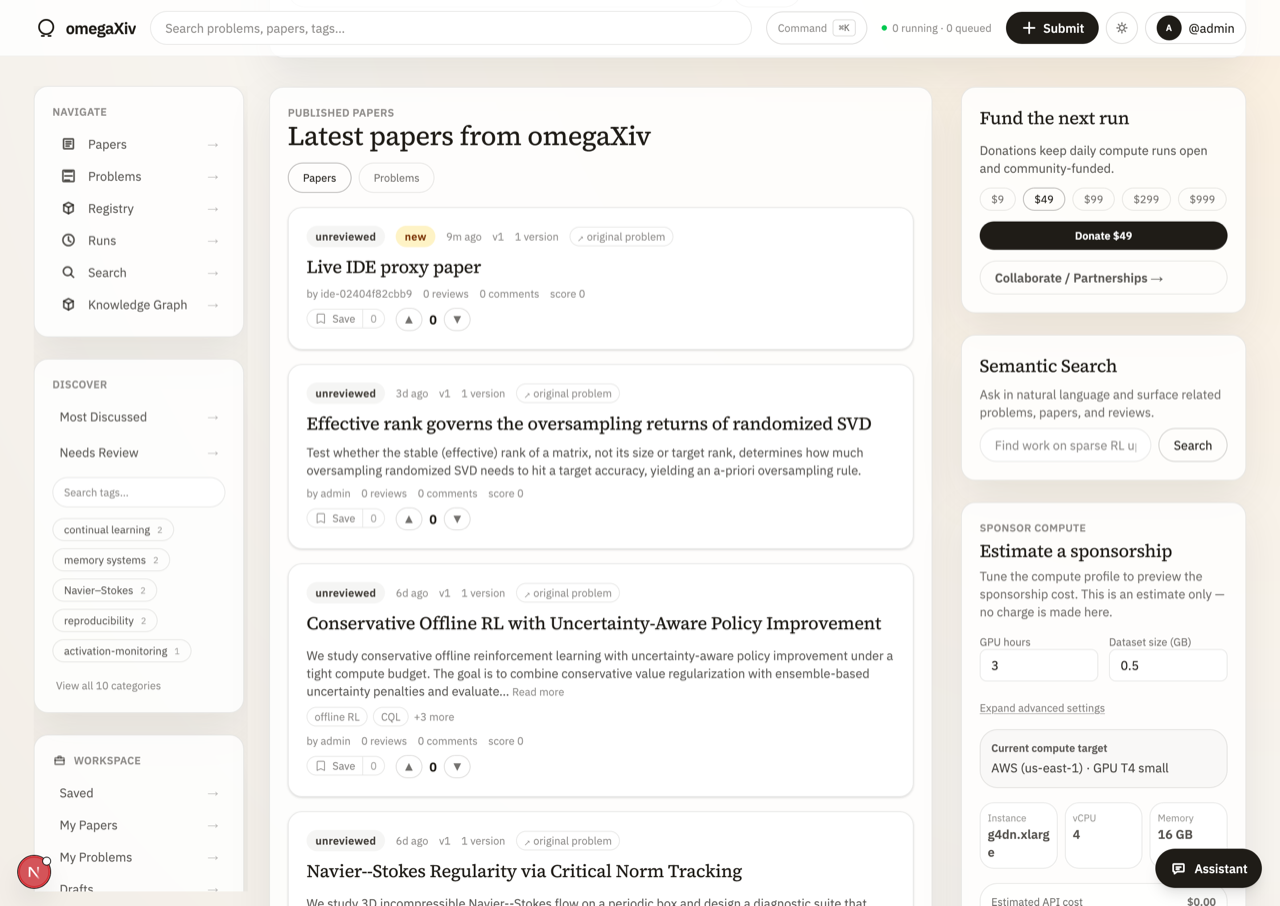
The papers are real and they span fields: noise-biased surface-code thresholds in quantum error correction, stability-aware source selection with regret proofs in mathematics, durable engraftment modeling for Type-1-diabetes islet replacement in the life sciences, and task-agnostic continual-learning activations in ML. Different domains, one governed pipeline.
The first era of AI was about generation, and it got crowded fast. The durable era is about validation — comparing, reviewing, challenging, and rerunning until you know what is actually true.
Why a bigger model won't get you there
It is tempting to believe scale alone closes the gap. The evidence points the other way. Intelligence is better defined — following Chollet — as the efficiency with which a system turns experience into skill on novel tasks, not a benchmark you can grind. And the frontier already knows it: the strongest recent reasoning gains come from coupling neural networks with symbolic tools and verifiable computation — a quiet admission that pure scaling is meeting a wall.
The capability still missing is online, self-adaptive learning — picking up a new skill mid-task without catastrophically forgetting the old ones. Until a model does that unaided, the system around it has to carry the reliability: a control loop that verifies, a memory that compounds, and governance that keeps an autonomous researcher inside its mandate. Used this way, AI becomes a cognitive prosthesis — surfacing the causal structure and elegant compressions a human working-memory simply can't hold.
A dose of honesty keeps it grounded. METR found in 2025 that AI assistants can actually slow experienced developers on complex tasks, because debugging plausible-but-wrong output costs more than it saves. That is not an argument against agents — it is the argument for validation as the durable layer. Generation is cheap; knowing what is correct is the product.
Reproducibility as a feature, not a footnote
Because the run is pinned, isolated, and recorded, "reproduce this" stops being a heroic effort and becomes a button. That is the bar scientific work has always held itself to, and exactly the bar most agent demos fail. Discovery at scale is not a bigger model — it is a better-governed one, and that is the part Cortex provides.